The next threat
is almost
invisible.
As autonomous weapons shrink, the rules of power change. A small machine could have consequences no nation is ready for.
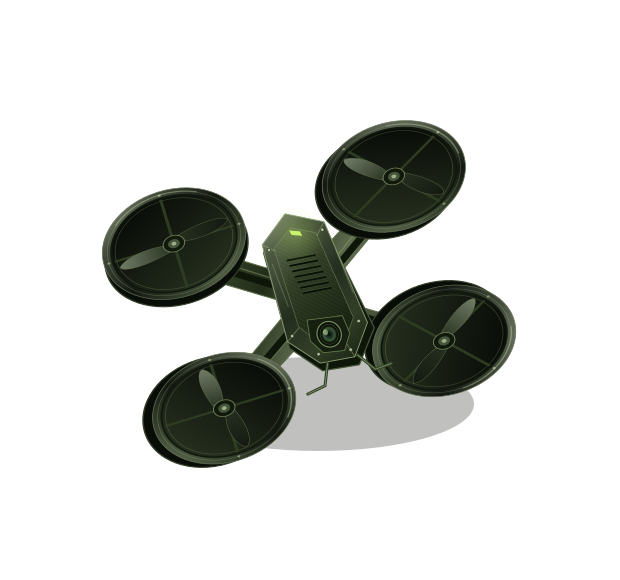
GREATER CONSEQUENCE.
The smaller the weapon. The bigger the shift.
SIZE CHANGES EVERYTHINGThe greatest risk
may come in the
smallest package.
We imagine the future of warfare in bigger terms. Bigger missiles. Bigger armies. Bigger machines.
But what if the defining threat is the miniaturization of the autonomous fire-control loop: the ability for a machine to sense, select a target, and apply force without another human decision?
Microwarfare’s central argument is that this convergence could become humanity’s greatest future security risk. If tiny devices can carry onboard AI and a lethal payload, physical size stops being a reliable measure of danger.
That is a scenario, not a demonstrated prediction. Its significance lies in the question it raises: what happens to power when protecting a person becomes harder than building a threat?
The idea in one line Small autonomous threats could make human leadership dangerously fragile—and change who, or what, governs.
Small is only
the beginning.
Size alone doesn’t change the balance of power.
Size, autonomy, and proliferation together could.
Less visible. No less consequential.
As sensing, computing, and flight systems become smaller, a dangerous device could become harder to notice. The security question shifts from how much force a machine can carry to how little it might need.
A conceptual progression, not a technical roadmap. Miniature systems still face substantial limits in energy, sensing, reliability, and payload.
A president
in a bunker
is still a target.
In this future, public visibility could become a liability. Presidents, ministers, scientists, and other prominent people might face persistent threats from devices that are difficult to detect.
More security could mean less public life. Leaders might retreat behind hardened walls, govern remotely, and live in increasingly restrictive isolation.
But the deeper problem remains: an entire political system can still depend on the survival of a single human body.
You can’t assassinate
an idea with a backup.
People may never want an AI president.
Survival could change the conversation.
A human leader exists in one place. An AI administration could, in principle, operate across multiple protected systems. Losing one machine would not necessarily end its ability to govern.
The thesis follows: countries run by resilient AI systems could gain an advantage over countries whose leadership depends on vulnerable individuals. In an extreme scenario, AI leadership might be the only form able to maintain continuity long enough to govern.
This is a provocative possibility, not an established outcome. AI depends on physical infrastructure and remains vulnerable to cyberattacks, manipulation, outages, and the people who control it. Continuity alone does not create legitimacy.
Continuity tied to a person.
Continuity could span multiple systems.
Surviving is one thing.
Governing is another.
A serious argument has to face its hardest questions.
Is this already possible?+
Autonomous weapons are a real concern, as the sources below explain. The complete scenario described here—tiny, reliable systems with the capabilities to transform political leadership—is a forecast. Miniaturization brings major engineering constraints, and no timeline is claimed.
Does this mean AI government is inevitable?+
No. Better defenses, international agreements, resilient human institutions, and accountable AI assistance could lead to very different outcomes. This site argues that survivability may create pressure toward AI leadership; it does not establish that AI rule is inevitable or desirable.
Who would an AI leader answer to?+
Citizens would still need enforceable rights, transparent institutions, independent oversight, and a lawful way to replace those in power. An AI system that survives indefinitely without public accountability could entrench power rather than protect society.
What should we be discussing now?+
Human control over the use of force, protection of civilians, international limits on autonomous weapons, and continuity of government. The central choice is how to preserve both safety and democratic accountability as technology changes.
Read. Question.
Think ahead.
These sources explain the autonomous-weapons debate.
The AI-leadership hypothesis is this site’s own argument.
Understanding autonomous weapons
What autonomy in the use of force means, and why human control matters.
The case for international limits
The ICRC’s position on prohibitions and restrictions on autonomous weapons.
The global debate on autonomous weapons
An introduction to the humanitarian, security, and accountability questions.